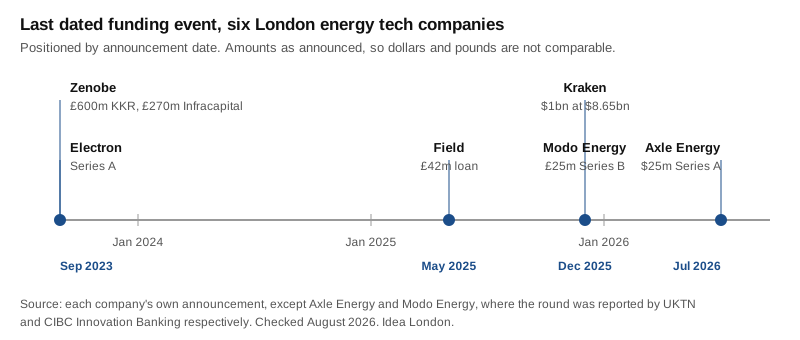
Six London energy tech companies with a dated funding round each: Kraken at $8.65bn, Axle Energy's $25m Series A, Zenobe, Field, Modo Energy and Electron.
Energy Tech Startups London
London is the second largest cluster of venture-backed climate tech companies in the world. Dealroom’s climate tech guide, updated through July 2026, counts 670 in the city, behind the Bay Area’s 738. Companies in the London metro region raised $2.4bn in the twelve months to the second quarter of 2026.
That is the whole climate category, not energy alone. Below are six energy-specific companies, each with a funding event we could date and source.
Six companies and their last named round
| Company | What it does | Last dated funding event |
|---|---|---|
| Kraken (Octopus Energy) | Utility software platform, spun out of Octopus | $1bn raised at an $8.65bn valuation, 29 Dec 2025, led by D1 Capital Partners |
| Axle Energy | API connecting home EV chargers, batteries and heat pumps to energy markets | $25m Series A, 8 July 2026, led by Energize Capital |
| Modo Energy | FCA-regulated benchmarks and forecasts for battery and renewable assets | $17m growth facility from CIBC Innovation Banking, July 2026, after a £25m Series B led by Molten Ventures in December 2025 |
| Zenobē | Grid-scale batteries and electric fleet infrastructure | £600m from KKR plus £270m from Infracapital, 7 Sep 2023 |
| Field | Builds and operates grid-scale battery storage | £42m loan from Rabobank and ING, 19 May 2025 |
| Electron | Market platform for network operators trading grid flexibility | Series A, September 2023. Acquired US data-analytics firm Rhythmos in 2025 |
The dates matter as much as the amounts. Zenobē’s headline round is nearly three years old, which tells you it is a capital-intensive infrastructure business funded largely by debt between equity rounds, not a company that has gone quiet.
What each one has actually built
Funding is an input. These are the outputs, which are harder to inflate.
Kraken licenses the software Octopus built to run its own supply business. It now serves more than 70 million utility accounts worldwide, with contracted revenues above $500m a year. Octopus Energy itself supplies 11 million households globally and will keep a 13.7% stake in Kraken after the demerger.
Axle Energy has 300,000 devices live on its platform and around 2GW of shiftable load, according to its own site. Its business is aggregating domestic assets into a virtual power plant that utilities and manufacturers can dispatch.
Zenobē powered up phase one of the Blackhillock battery in Moray on 3 March 2025. At 200MW it was Europe’s largest battery and the UK’s first grid-forming one, meaning it can help hold system frequency rather than just absorb and release power. A second phase takes it to 300MW/700MWh.
Field reached financial close on 239MW/1GWh of projects, with sites at Whitebirk, Holmston and Drum Farm coming online through 2027.
Modo Energy is unusual in this list: it sells data, not electrons. Its battery revenue benchmarks are FCA-regulated and IOSCO-certified, which is why lenders and asset managers use them in valuations.
Electron runs the trading platform network operators use to procure flexibility. It moved into the United States in 2025 by acquiring Rhythmos.
Corrections to the older version of this list
Two claims that circulated widely are wrong.
- Moixa was not acquired by TEPCO. It was bought by Lunar Energy in August 2022, a US company founded by a former Tesla executive. TEPCO was an earlier investor, not the buyer. Moixa’s GridShare software went with the deal.
- GridBeyond is not a London company. It is headquartered in Dublin, so it is out of scope for a London list regardless of how well it is doing.
We have also dropped a set of round numbers that appeared without a source: “200+ active energy startups”, “£1.2bn over five years”, sector counts like “45+ renewable energy startups”, and a jobs figure. None of them could be traced to a publisher with a method. The Dealroom counts at the top of this page are the closest verifiable equivalent.
Where the money is going
Global climate tech venture funding was $19.5bn in the first half of 2026, on Dealroom’s numbers, against $39.0bn for the whole of 2025. That is a flat year, not a collapse and not a boom.
The London pattern within it is worth noting. The clearest recent wins are not hardware moonshots. They are software layers sitting on top of physical assets: Kraken selling billing and dispatch to other utilities, Modo selling benchmarks to investors, Axle selling an API to carmakers and charger manufacturers. Two of the three largest funding events in the table are software companies.
The capital-intensive side, Zenobē and Field, is funded differently. Both raise infrastructure debt against contracted revenue rather than repeated equity rounds. If you are benchmarking a battery developer against a SaaS company on funding raised, you are comparing two unrelated things.
Frequently asked questions
What is the biggest energy tech company in London?
By valuation, Kraken, the software platform spun out of Octopus Energy at $8.65bn in December 2025. Octopus Energy Group itself is larger as a business, supplying 11 million households, but its most recently disclosed valuation event is the Kraken transaction.
Is London a good place to start an energy tech company?
The cluster is real: 670 venture-backed climate tech companies, second only to the Bay Area, and $2.4bn raised in the region in the year to Q2 2026. What London does not have is manufacturing. The companies above that scaled fastest sell software into energy markets. Hardware businesses in this sector tend to sit elsewhere in the UK, near industrial capacity.
How do I check whether an energy startup is still trading?
Companies House filings are the fastest answer. An overdue set of accounts or a filed insolvency notice will tell you before any startup directory does. Several companies named on older London energy lists have since been acquired or wound up.