Eight London angel networks and what each needs from you: ACF wants three angels and a £40k lead, Cambridge Angels caps membership at 65. Updated August 2026.
London Angel Investor List
A list of names is not much use on its own. What a founder needs is the entry requirement: who each network lets in, what it expects you to have already, and whether it writes a cheque itself or just makes introductions.
So this list gives the terms rather than the reputation. Every entry comes from the organisation’s own website, checked in August 2026.
The networks
| Network | What it actually is | What it requires or invests |
|---|---|---|
| ACF Investors (Angel CoFund) | A £100m fund that co-invests, never leads | A syndicate of at least three sector-focused angels, with a lead putting in at least £40,000. Its Delta Fund instead wants one experienced lead at £70,000+ |
| Envestors | FCA-authorised investment platform, running since 2004 | Over 4,000 investors and advisers on the network. £180m+ raised for companies to date |
| Cambridge Angels | A closed member group, investing since 2001 | Membership capped at 65 individuals, plus corporate VC members. More than 150 companies backed |
| SFC Capital | The UK’s largest SEIS fund, FCA FRN 736284 | 15 to 20 companies per fund. £160m+ under management, 600+ portfolio companies, 2,000+ investors |
| Angel Academe | Angel network plus the UK’s first EIS fund for female founders | Female-founded companies only. Active since 2014 |
| Angel Investment Network | An open pitch listing site, not a curated syndicate | Free to post a pitch. Paid “Featured” placement for visibility |
| SyndicateRoom | A fund, not a network. See the correction below | Access EIS builds 30+ company portfolios, co-investing behind 183 identified angels |
| UKBAA | The trade body, not an investor | Its member directory is the fastest way to find the regional or sector group that fits |
Two of those are doing something different from the rest. ACF and SFC deploy their own capital. Envestors and Angel Investment Network are distribution: they put your deck in front of people who may or may not invest.
What changed since the older lists
Directories of London angels tend to get copied rather than checked. Three entries that appear on most of them are out of date.
- SyndicateRoom is not an angel co-investment platform. It stopped offering individual equity crowdfunding deals in October 2019 and now runs the Access EIS fund. You cannot pitch it the way you pitch a syndicate.
- London Business Angels now trades as Newable Private Investing. The ScaleUp Institute’s listing records the network under the Newable name.
- Angel CoFund is part of ACF Investors, alongside a second vehicle called the Delta Fund. The two have different lead-investor thresholds, as the table shows.
How big the market actually is
The UK Business Angels Association published The UK Angel Investment Market 2025 on 29 June 2026. It draws on angel-group survey data and HMRC returns. Its findings:
- The UK’s active angel base grew 54% since 2022, from 36,800 to 56,800.
- The number of angels with five or more deals rose 95%. Portfolio investing is now the default, not the exception.
- Angel groups themselves put in £53m, but that money anchored £348m of total round value. They supply roughly 15% of a round and pull in the other 85%.
- Those groups reported supporting more than 8,000 founders and 8,100 jobs created.
Note what the £53m figure is not. It is not all UK angel money. It counts what surveyed angel groups deployed, which is a fraction of the individual angels investing outside any group.
The tax-scheme numbers, which are harder to argue with
Most UK angel investment runs through EIS or SEIS, because the tax relief is the reason many angels invest at all. HMRC publishes the totals. The May 2026 release covers the 2024-25 tax year:
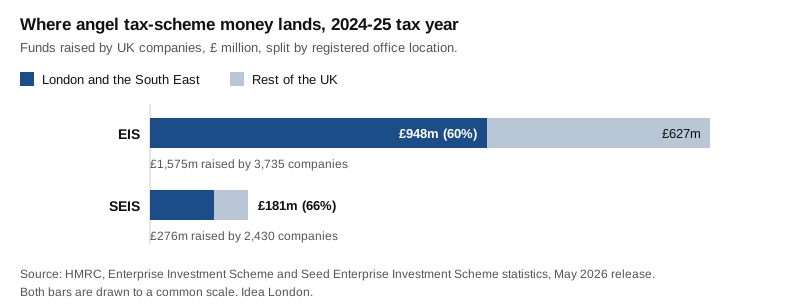
- EIS: 3,735 companies raised £1,575m. Flat on the previous year.
- SEIS: 2,430 companies raised £276m, up 14% after the April 2023 limit increase to £250,000 per company.
- London and the South East took 60% of EIS money (£948m) and 66% of SEIS money (£181m).
- Information and communication was the largest EIS sector at £550m, 35% of the total.
That regional concentration is the real argument for a London-specific list. Three fifths of EIS capital lands in one corner of the country.
It is also slipping. London and the South East took 65% of EIS funds in 2022-23 and 63% in 2023-24, against 60% now. HMRC notes EIS investment in the North East doubled over the year.
What angels put in per deal
HMRC also publishes the distribution of individual investments, which is more useful than any “typical cheque size” claim. Under SEIS in 2024-25, 56% of investors claiming income tax relief put in £10,000 or less. Investments above £25,000 still made up 66% of the money.
In other words, most angels are small and a minority carry the round. Since the April 2023 expansion, an SEIS investor can claim relief on up to £200,000, doubled from £100,000.
Approaching a network
Sequence matters more than volume. Working through the eight above:
- Find your lead first. ACF will not invest without one, and neither will most syndicates in practice. A lead who knows your sector is worth more than five passive cheques.
- Check advance assurance before you pitch. HMRC received 4,085 SEIS advance assurance applications in 2025-26, and 76% were approved as at March 2026. Angels investing for the relief will ask for it.
- Match the vehicle to your stage. SEIS caps at £250,000 per company. If you need more than that, you are in EIS territory and talking to a different group of people.
- Do not pay to be introduced. Listing sites charging for visibility are advertising, not endorsement. Judge them on that basis.
Frequently asked questions
How many angel investors are there in London?
Nobody publishes a reliable London-only count, and any list quoting one is guessing. The UKBAA’s 2026 report puts the UK-wide active angel base at 56,800. What is measured regionally is the money: HMRC recorded £948m of EIS investment in companies registered in London and the South East in 2024-25, 60% of the UK total.
What is the difference between an angel network and an EIS fund?
A network introduces you to individuals who each decide for themselves. A fund has already raised the money and one investment committee decides. SFC Capital and SyndicateRoom’s Access EIS are funds. Cambridge Angels is a network. ACF Investors is a fund that will only act once a network has already committed.
Do I need a syndicate before applying to Angel CoFund?
Yes. ACF requires at least three sector-focused angel investors already committed, including a lead putting in £40,000 or more. That is its stated model: it co-invests behind angels rather than leading rounds itself.