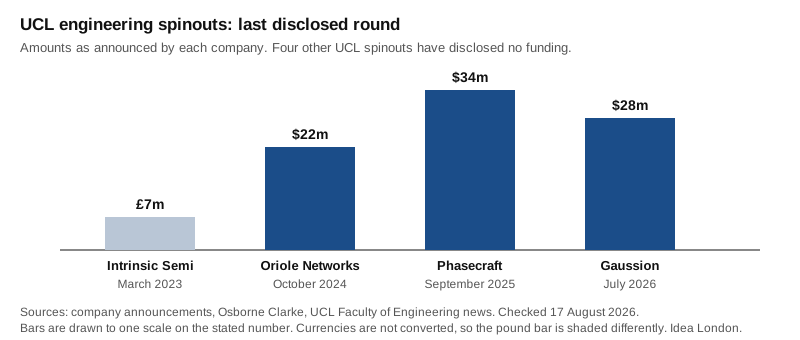
Nine UCL engineering spinouts with a dated round each: Oriole Networks $22m, Phasecraft $34m, Gaussion $28m. Plus three companies wrongly credited to UCL.
UCL Engineering Startups
Most lists of UCL engineering startups repeat the same four or five names, and at least two of those companies came out of a different university. This one only includes companies where UCL, UCL Ventures or the company itself has said on the record that the technology came from a UCL department.
Each entry carries one dated funding event. Where nothing recent has been disclosed, the entry says so rather than filling the gap with an estimate.
The spinouts, with their last disclosed round
| Company | What it does | UCL origin | Last disclosed funding |
|---|---|---|---|
| Oriole Networks | Photonic networking to train AI models faster | Dept of Electronic and Electrical Engineering, spun out 2023 | $22m Series A, October 2024, led by Plural. Over £25m raised in total as of June 2026 |
| Phasecraft | Hardware-agnostic quantum algorithms | UCL Quantum Science and Technology Institute with Bristol, spun out 2019 | $34m Series B, 2 September 2025, co-led by Plural, Playground Global and Novo Holdings |
| Gaussion | Magnetic field control for faster lithium-ion charging | UCL and Faraday Institution spinout, founded 2022 | $28m, July 2026, co-led by BGF and AlbionVC |
| Intrinsic Semiconductor Technologies | Memristive RRAM memory devices | Dept of Electronic and Electrical Engineering, founded 2017 | £7m led by Octopus Ventures, March 2023, plus £1m in Innovate UK grants |
| Abacqus | Dopant-in-silicon quantum computing platform | UCL EEE and the London Centre for Nanotechnology | None disclosed. Selected for ChipStart UK, March 2026 |
| Orbicom | Spin-orbit qubit architecture on semiconductors | UCL EEE and the London Centre for Nanotechnology | None disclosed. ChipStart UK, March 2026 |
| Altro Photonics | Photonic integrated circuits for data centres | UCL EEE | None disclosed. ChipStart UK, March 2026 |
| Nibras Communications | Ultra-low-noise photonic signal sources for satellites | UCL EEE | None disclosed. ChipStart UK, March 2026 |
| Odin Vision | Cloud AI for endoscopy | Wellcome/EPSRC Centre for Interventional and Surgical Sciences at UCL | Acquired by Olympus, announced December 2022, for up to £66m in upfront and milestone payments |
Four of those nine are quantum or photonics companies out of one department. UCL’s Electronic and Electrical Engineering department, working with the London Centre for Nanotechnology, is where the current spinout activity is concentrated.
The ChipStart cohort tells you where UCL is betting
ChipStart UK is a semiconductor incubator funded by the Department for Science, Innovation and Technology and delivered by SiliconCatalyst.UK. In March 2026 UCL supplied four of the companies in the cohort, chosen from around 40 national submissions.
That is a third of the intake from one university. None of the four has announced a funding round, so treat them as research at the point of leaving the lab, not as businesses with a revenue line.
What Oriole Networks is now attached to
Oriole is the furthest along of the current engineering spinouts. In June 2026 UCL confirmed it as part of AMD’s £2bn commitment to UK AI and semiconductor research. Oriole’s PRISM photonic networking system is being deployed alongside AMD hardware in the ARIA Scaling Inference Lab, a £50m testbed.
The investor list behind it is worth reading: Plural led the Series A, with UCL Technology Fund, XTX Ventures, Clean Growth Fund and Dorilton Ventures alongside.
How UCL ranks for spinouts
The Royal Academy of Engineering published Spotlight on Spinouts 2026 on 3 June 2026. It put UCL third in the UK and seventh in Europe. The supporting figures:
- around 64 UCL spinouts with venture capital backing
- close to £2bn raised by those companies
- roughly £5.5bn of value created
- seven of the UK’s top 20 spinout exits of the past decade, second only to Oxford
Those numbers cover every UCL faculty, not engineering alone. Autolus Therapeutics and Orchard Therapeutics, the two the report singles out, are both life sciences companies.
Who to contact at UCL
UCL Business was renamed UCL Ventures in July 2026. The old uclb.com address now redirects to uclventures.com. If you are working from an older directory, that is why the contact links break.
UCL Ventures holds the spinout portfolio and handles licensing and company formation. The UCL Technology Fund invests alongside it, and appears on the cap table of Oriole, Gaussion and Intrinsic.
Three companies that are not UCL engineering startups
These appear on most lists of UCL spinouts. None of them belongs there.
- Oxford PV. The company’s own site says it was established in 2010 as a spinout from Professor Henry Snaith’s lab at the University of Oxford. It is a perovskite solar company with no UCL origin.
- Surrey Satellite Technology. Founded at the University of Surrey. The confusion appears to come from UCL’s Mullard Space Science Laboratory also working in space instrumentation.
- DeepMind. Not a spinout. UCL owned no share of it. Demis Hassabis did his PhD at UCL and met Shane Legg at UCL’s Gatsby Computational Neuroscience Unit, and UCL reported the Google acquisition in January 2014. The widely quoted £400m price was never confirmed by Google.
The distinction matters if you are a founder. A spinout means the university licensed the intellectual property and usually holds equity. An alumni-founded company means somebody who studied there started a business, which carries no institutional relationship at all.
Frequently asked questions
How many spinouts does UCL have?
The Royal Academy of Engineering counted about 64 UCL spinouts with venture capital backing in Spotlight on Spinouts 2026. The full portfolio, including companies with no VC on the cap table, is larger. UCL Ventures publishes the current list.
Which UCL department produces the most engineering startups?
Electronic and Electrical Engineering, on current evidence. It is the origin of Oriole Networks, Intrinsic Semiconductor Technologies and all four of UCL’s March 2026 ChipStart companies, usually in partnership with the London Centre for Nanotechnology.
What is the biggest UCL engineering exit?
Among engineering spinouts with a disclosed price, Odin Vision’s sale to Olympus for up to £66m is the largest we can verify. UCL’s largest exits overall have been in life sciences.
Does UCL invest in its own spinouts?
Yes, through the UCL Technology Fund, which is managed independently and has taken part in rounds for Oriole Networks, Gaussion and Intrinsic Semiconductor Technologies.