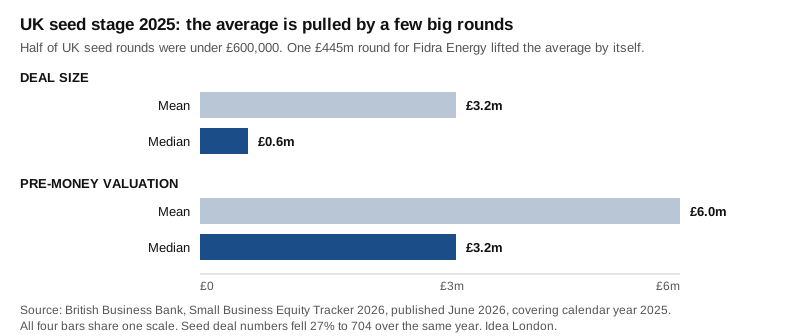
UK seed deals fell 27% to 704 in 2025 while the money held at £2.1bn. Median round £0.6m, mean £3.2m, and 14.4 months between raises. British Business Bank.
UK Pre-Seed Funding Data
Start with the awkward part. Nobody publishes a UK pre-seed dataset. The British Business Bank and Beauhurst, whose figures underpin most UK equity reporting, classify companies as seed, venture or growth. There is no pre-seed category to count.
Any page quoting a precise pre-seed total for the UK has either invented it or silently relabelled seed-stage data. What follows uses the two measures that do exist, and says which is which.
The two things that are actually measured
- Seed-stage equity, from the British Business Bank’s Small Business Equity Tracker 2026, published June 2026 and covering calendar 2025. It counts announced deals, so it misses private rounds.
- SEIS, from HMRC. The Seed Enterprise Investment Scheme is capped at £250,000 per company and is the closest thing the UK has to a pre-seed register, because the tax relief creates a paper trail.
Neither is complete. Read together they bracket the market.
Seed stage in 2025
| Measure | 2025 | Change on 2024 |
|---|---|---|
| Seed deals | 704 | -27% |
| Seed investment | £2.1bn | Flat |
| Mean deal size | £3.2m | +41% |
| Median deal size | £0.6m | Flat |
| Mean pre-money valuation | £6.0m | +3% |
| Median pre-money valuation | £3.2m | +4% |
| Median months since last round | 14.4 | Up from 12.4 |
Seed suffered the sharpest drop in deal numbers of any stage. Venture stage fell 13% and growth stage 4%. The total market took 2,002 deals, down 17%, the lowest count since 2016.
The money did not leave. It went to fewer companies.
Ignore the average round size
The £3.2m mean is the highest on record and it is close to meaningless. One deal did most of the work: Fidra Energy, a battery storage business, raised £445m in Q3 2025 in what the Bank records as a seed-stage round. It was the largest seed deal since 2020.
Strip that single round out and the average rose 11%, not 41%.
The median tells the truer story. It stayed flat at £0.6m. Half of all UK seed rounds were smaller than £600,000. If you are raising a first institutional round and someone quotes you a £3m average, they are quoting a number bent by one battery company.
It now takes longer between rounds
The median gap between successive raises for seed-stage companies went from 12.4 months in 2024 to 14.4 months in 2025.
The pattern reversed further up. At growth stage the gap shortened from 18.5 months to 15.1. Capital moved towards companies with revenue and away from companies with a plan. HSBC Innovation Banking’s Venture Capital Term Sheet Guide 2026, quoted in the same report, found priced seed rounds becoming more investor-friendly and more complex over the year, while growth-stage terms became simpler and more founder-friendly.
Plan for 14 months of runway between raises at this stage, not 12.
Where the earliest money comes from
Announced VC deals are the visible part. Most genuine pre-seed money is angel money, and it shows up in different places.
- SEIS. HMRC’s May 2026 release covers the 2024-25 tax year: 2,430 companies raised £276m, up 14% on the year. Deal volumes rose 5%. The rise partly reflects the April 2023 expansion, which lifted the company limit to £250,000.
- EIS. 3,735 companies raised £1,575m, flat year on year, with volumes down 1%.
- Angel groups. A UKBAA survey found 27 angel groups invested £53m across 321 deals in 2025.
The contrast is the finding. Announced seed deal volumes fell 16% over the 2024-25 tax year while SEIS and EIS volumes held up. When institutional seed investors pulled back, angels did not.
The latest quarter
Q1 2026 is the most recent data in the Tracker. UK smaller businesses raised £1.5bn across 418 deals. Against Q4 2025 that is 3% fewer deals and 43% less money.
Deal volumes in Q4 2025 and Q1 2026 were among the lowest on record, close to 2015 levels.
The wider market looks better only because of size. Across all businesses, £4.6bn was invested in Q1 2026, and about £3bn of it came from three rounds: £1.5bn for NScale, £1.1bn for Wayve and £0.4bn for ElevenLabs.
Where the deals are
London took 48% of UK equity deals in 2025 and 57% of the value. Both fell for the second year running, from 49% and 60%.
That is the second consecutive year London has been less resilient than the rest of the country. Deal volumes fell 18% in London against 14% elsewhere, and value fell 9% against 0.6%.
Older copies of this page claimed London accounted for 68% of early-stage deals. That was never sourced and it is not what the data shows.
Founder gender, measured rather than asserted
An earlier version of this page said startups with diverse founding teams were 23% more likely to secure pre-seed funding. The published data points the other way.
- All-female founder teams took 7% of UK equity deals in 2025 and 2% of the investment value. Both figures match the ten-year average.
- Teams with at least one female founder took 25% of deals, down three points, and 15% of value, down from 18%.
- Those 438 deals compare with 1,347 for all-male teams, and £9.3bn of value went to the all-male group.
- Of the 321 AI deals above £10m completed since 2021, one involved an all-female founding team.
HMRC’s data on who is investing runs the same way. Across 2022-23 to 2024-25, women made 19% of EIS claims and 18% of SEIS claims, and 14% of the value in both schemes.
What changed on this page
The previous version carried figures with no published source behind them. They have been removed rather than updated:
- “£2.3bn pre-seed funding raised in 2024” and “1,450 pre-seed deals tracked”. No UK body publishes pre-seed totals.
- “£580K average deal size”, presented as an average when the real average is £3.2m and the real median is £0.6m.
- Sector shares (fintech 28%, healthcare 19%, SaaS 16%) with no source. The measurable sector fact for 2025 is that AI companies took 44% of UK equity investment and 26% of deals, both records, against 16% of investment in 2023.
- “67% of pre-seed startups raise seed within 18 months”, up from 43%. Not published anywhere, and the direction contradicts the lengthening 14.4-month gap between rounds.
- The Future Fund, cited as a current government initiative. It closed to applications in January 2021.
Frequently asked questions
What is the average UK pre-seed round?
There is no official pre-seed figure. At seed stage, the median UK deal in 2025 was £0.6m and the mean was £3.2m. The gap is caused by a handful of very large rounds, so the median is the better guide. Under SEIS, which is the closest proxy for genuine pre-seed, a company can raise at most £250,000.
How long does it take to raise pre-seed in the UK?
The Bank does not measure the length of a fundraising process. It measures the gap between rounds, which for seed-stage companies was a median of 14.4 months in 2025, up from 12.4 months.
Is UK pre-seed funding growing?
Not on volume. Seed-stage deal numbers fell 27% in 2025, the sharpest fall of any stage. Total seed money held at £2.1bn, so fewer companies raised larger rounds. SEIS was the exception, up 14% in value in 2024-25.
What pre-money valuation should I expect at seed?
The median UK seed pre-money valuation was £3.2m in 2025 and the mean was £6.0m. Both were records, but the median fell 9% between the first and second halves of the year, so the trend within 2025 was down.