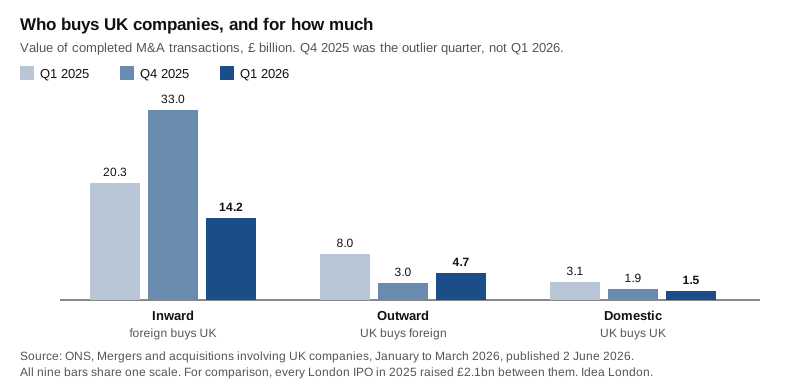
Foreign buyers took £14.2bn of UK companies across 163 deals in Q1 2026, down from £33.0bn in Q4. London IPOs raised £577m in H1 2026. ONS and EY figures.
UK Startup Exit Analysis
A UK company leaves private hands in one of two ways. Somebody buys it, or it lists. Both routes are counted quarterly by public bodies, so an exit analysis does not need estimates.
The figures below come from the Office for National Statistics and from EY’s tracking of London listings. Where a specific deal is named, the price is the one the acquirer announced.
The acquisition route
The ONS publishes M&A involving UK companies every quarter. Its January to March 2026 bulletin, released on 2 June 2026, is the latest.
| Type of deal | Q1 2026 value | Deals | Q4 2025 value | Q1 2025 value |
|---|---|---|---|---|
| Foreign companies buying UK companies | £14.2bn | 163 | £33.0bn | £20.3bn |
| UK companies buying foreign companies | £4.7bn | 72 | £3.0bn | £8.0bn |
| UK companies buying UK companies | £1.5bn | 117 | £1.9bn | £3.1bn |
Read the direction of travel before the level. Inward acquisitions fell £18.8bn from the previous quarter and were £6.1bn below the same quarter of 2025. Domestic deals more than halved in count against Q1 2025, from 183 to 117.
Two things follow for a founder planning an exit.
- The buyer is usually foreign. Inward deals were worth roughly nine times domestic ones in Q1 2026. That has been the shape of the UK market for years.
- Q4 2025 was the outlier, not Q1 2026. A £33.0bn quarter is not the baseline against which to judge a £14.2bn one.
The listing route
London’s IPO market improved through 2025 and has kept improving.
- 2025 brought 23 listings, 9 on the main market and 14 on AIM, raising £2.1bn. That was a 170% increase on 2024, when 18 issuers raised £777.7m. The figures come from EY’s IPO Eye, published 6 January 2026.
- The recovery was concentrated at the end of the year. Q4 2025 alone produced 11 IPOs raising £1.9bn, most of the annual total.
- The first half of 2026 brought 7 listings raising £577m, 3 on the main market and 4 on AIM. That is 215% more money than the £183m raised in H1 2025, with five of the seven landing in Q2.
Set that against the acquisition figures and the ranking is stark. London’s entire 2025 IPO market raised £2.1bn. Foreign buyers spent £14.2bn on UK companies in one quarter of 2026. For almost every company, the exit is a trade sale.
Exits you can check
Four completed deals with a disclosed price and a confirmed completion date:
- Deliveroo to DoorDash. Completed 2 October 2025, valuing Deliveroo at about £2.9bn. It still appears as an independent London company on most startup lists.
- Alphawave Semi to Qualcomm. Completed 18 December 2025 at $2.4bn, a quarter earlier than scheduled.
- Oxford Ionics to IonQ. Completed 17 September 2025 at $1.075bn, made up of $1.065bn in IonQ stock and about $10m in cash.
- Freetrade to IG Group. Completed 1 April 2025 at £160m, roughly 29% below the company’s previous funding valuation.
Two of those four matter beyond their price.
Oxford Ionics was cleared under the National Security and Investment Act with conditions attached: the trapped-ion hardware, staff, intellectual property and manufacturing capacity stay in the UK. Deep tech founders selling to an overseas acquirer should assume a national security review is part of the timetable.
Freetrade is the reminder that an exit is not automatically an uplift. A sale can and often does price below the last round.
The third route nobody calls an exit
Beauhurst’s Exits in the UK research, produced with Charles Stanley, counts a category the ONS does not: founder-led secondaries, where founders and early investors sell part of their holding while the company carries on independently.
Beauhurst counts nearly 8,000 UK startup exits since 2015 across acquisitions, IPOs and secondaries, with close to 40% of them falling in the most recent two and a half years. Secondary transactions have grown fastest.
This is why headline exit counts and headline exit values disagree so often. A partial founder sale registers as an exit event in some datasets and as nothing at all in others.
What was removed from this page
The previous version of this page was built on numbers with no source and three companies that do not exist. All of it has gone:
- “FintechCorp”, “HealthTech Solutions” and “SaaS Innovations”, listed as notable 2024 exits worth £2.8bn, £1.2bn and £890m. No such companies.
- “£47.8bn total exit value 2024”, “312 successful exits”, “89% acquisition rate”. Not published by anyone.
- “24 IPO listings in 2024”. There were 18 issuers on the London Stock Exchange in 2024, raising £777.7m between them.
- Sector exit values for fintech, enterprise SaaS and healthtech, each with a year-on-year growth rate attached.
- Revenue multiples of 4.2x for SaaS and 2.8x for other tech, average exit timelines of 7 to 9 years, and a claim that Q4 accounts for 32% of annual exit value.
- A “start free trial” funnel for a database of 2,000 exits that was never built.
Frequently asked questions
How many UK startups exit each year?
There is no single count, because the answer depends on whether partial sales count. The ONS recorded 352 completed M&A transactions involving UK companies in Q1 2026 across inward, outward and domestic deals, but that covers all companies rather than startups. Beauhurst, which tracks high-growth companies and includes secondaries, counts nearly 8,000 exits since 2015.
Is an IPO or an acquisition more likely?
An acquisition, overwhelmingly. London had 23 IPOs in the whole of 2025. The ONS counted 163 inward acquisitions in a single quarter of 2026.
What was the biggest UK tech exit of 2025?
Among deals that completed with a disclosed price, Deliveroo’s sale to DoorDash at about £2.9bn was the largest, ahead of Qualcomm’s $2.4bn purchase of Alphawave Semi in December.
Will the government block a foreign acquisition of a UK startup?
Blocking is rare, but conditions are not. IonQ’s purchase of Oxford Ionics was cleared under the National Security and Investment Act only after undertakings to keep hardware, staff and manufacturing in the UK. Deep tech, semiconductors, quantum and defence-adjacent companies should build the review into the deal timetable.
Do exits happen at a premium to the last funding round?
Not reliably. IG Group acquired Freetrade for £160m in April 2025, about 29% below the valuation of its previous round. Down exits are common when a company is sold in a weaker market than the one it last raised in.