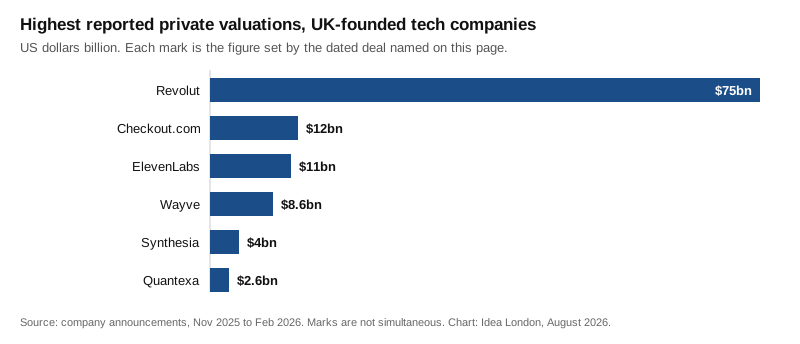
The highest UK private tech valuations, each with the deal that set it and the date: Revolut $75bn, Checkout.com $12bn, ElevenLabs $11bn, Wayve $8.6bn.
British Startup Valuation Tracker
A private company valuation is not a fact about the business. It is the price agreed in one transaction, on one date, by the people in that transaction. It stays accurate for exactly as long as nothing else happens.
So this tracker does one thing. For each of the largest UK-founded private technology companies it gives the valuation, the deal that produced it, and the day that deal was announced. Checked August 2026.
The current marks
| Company | Valuation | Set by | Announced |
|---|---|---|---|
| Revolut | $75bn | Secondary share sale led by Coatue, Greenoaks, Dragoneer and Fidelity | 24 Nov 2025 |
| Checkout.com | $12bn | Employee share buyback | 26 Sep 2025 |
| ElevenLabs | $11bn | $500m Series D led by Sequoia Capital | 4 Feb 2026 |
| Wayve | $8.6bn | $1.2bn Series D led by Eclipse, Balderton and SoftBank Vision Fund 2 | 25 Feb 2026 |
| Synthesia | $4bn | $200m round | Oct 2025 |
| Quantexa | $2.6bn | $175m Series F led by Teachers’ Venture Growth | 5 Mar 2025 |
Two things to note before using that table.
The marks are not simultaneous. Quantexa’s is seventeen months older than Wayve’s, and a lot happened in AI funding across those months. Ranking them against each other is therefore rough.
The instruments differ too. Revolut’s $75bn and Checkout.com’s $12bn came from share sales, where existing shareholders sold to new ones. ElevenLabs, Wayve and Quantexa raised primary capital into the business. A secondary sale price and a priced round are not quite the same kind of number, even when both are honest.
Why a tracker has to be dated
Checkout.com is the clearest case in the UK market. It was valued at $40bn in a 2022 round. The 2025 buyback put it at $12bn, a fall of about 70%. A page still quoting $40bn would not be slightly out of date. It would be wrong by $28bn.
Valuations can also go to zero. Builder.ai raised more than $450m and was valued above $1.3bn. It collapsed into insolvency in May 2025, after reporting revenue several times higher than the real figure.
The market behind the table
For context on how many British companies carry a billion-dollar mark at all, Dealroom’s unicorn tracker put the UK at 205 unicorn-tier companies as of August 2026. That is third in the world behind the United States and China, and first in Europe.
New capital is running hot. UK startups raised about $17bn in the first half of 2026, roughly double the first half of 2025 and the strongest opening half since 2022, on Dealroom and HSBC Innovation Banking data reported by UKTN. AI companies took about $12.6bn of it, close to three quarters. There were 28 rounds above $100m and four above $1bn.
The largest was Isomorphic Labs, the Alphabet drug-design company, which closed a $2.1bn Series B in May 2026. It is not in the table above because the round did not come with a disclosed valuation.
Checking a valuation yourself
You do not need a paid database to verify most of this. In order of reliability:
- The company’s own announcement. A priced round with a named lead investor and a stated valuation is the strongest evidence available. Everything in the table above comes from one.
- Companies House. Every UK company files share allotments on form SH01, which gives the number of shares issued and the price paid. Multiply by the fully diluted share count and you have a floor for the post-money valuation. Filings arrive within a month of the allotment.
- The annual accounts. These do not state a valuation, but they do state revenue, losses and cash. A company burning its last year of runway is unlikely to hold its last mark.
- Dealroom and Beauhurst. Both publish their methods and their dates. Use them for market-level counts rather than for a single company.
Treat two things with suspicion. Reported valuations attributed to unnamed sources ahead of a deal often do not survive the deal. And “estimated” valuations on aggregator sites are frequently derived from an old round with a multiple applied, which is a guess wearing a suit.
Frequently asked questions
Which British startup has the highest valuation?
Revolut, at $75bn. That figure was set by a secondary share sale led by Coatue, Greenoaks, Dragoneer and Fidelity, announced on 24 November 2025. It was up from $45bn the year before.
Is a secondary share sale a real valuation?
It is a real price, agreed between a seller and a buyer for existing shares. It is not the same as a priced funding round, where new money goes into the company and an investor sets terms. Both are evidence. A priced round is the stronger of the two.
How can I check a UK company’s valuation for free?
Use Companies House. Every UK company files an SH01 form when it issues shares, giving the number of shares and the price paid. Multiply the price per share by the fully diluted share count and you have a floor for the post-money valuation. Filings usually appear within a month.
How many UK unicorns are there?
Dealroom counted 205 UK companies at unicorn tier as of August 2026, third in the world after the United States and China. Counts differ between providers because each draws the boundary differently, so use the same source when comparing over time.
When was this page last checked?
August 2026. Every valuation in the table is dated to the announcement that produced it, so you can see for yourself how old each one is.
What this page dropped
The previous version of this page advertised a real-time dashboard, custom alerts, data exports and a demo. None of those existed. It also gave four headline statistics, including a £47.2bn total market value and 2,847 tracked companies, with no source and no date attached to either. All of that has gone, along with the attributed quotes from staff who cannot be verified as having existed.
What replaced it is shorter and checkable. If a figure here is stale, that is a bug worth reporting to hello@idea-london.co.uk.
Related: the UK unicorn company tracker, UK startup funding tracker and UK startup exit analysis.