London has 37,065 IT companies on the ONS count for March 2026, up 525 on 2025 and the biggest rise since 2019. Every borough's count, who gained, who lost.
IT Companies in London
The short answer
There were 37,065 IT companies in London on the newest official count, the government business register snapshot taken on 13 March 2026 and published by the Office for National Statistics on 24 September 2026. That is 525 more than a year earlier, the biggest one-year rise since 2019, and just under 30% of the UK’s 123,990. Almost all of them are small: 33,695 employ fewer than 10 people and only 140 employ 250 or more. Westminster now has the most, at 3,160, having overtaken Camden (3,145), with Hackney third on 2,750. Every figure on this page carries the date it was set and a link to the source it came from.
Most pages that answer this question are directories. They count the firms that have paid to be listed on them, which is why their totals run to a few hundred while the official register runs to tens of thousands. The figures below come from the register itself, and from the companies’ own filings and results announcements.
Most company profile pages are assembled from other company profile pages. The figures get copied forward, the dates get dropped, and after two years the profile describes a company that no longer exists in that form.
This page does the opposite. The official count of IT firms in the city, borough by borough, then eight London tech companies with one hard figure each, the date it was set, and the source. Then the method, so you can build a profile for any UK company yourself without paying for a database.
How many IT companies are there in London?
37,065, as at 13 March 2026. The number comes from UK Business Counts, the ONS series built from the Inter-Departmental Business Register, which covers every business registered for VAT or PAYE. It counts enterprises in Standard Industrial Classification division 62, “computer programming, consultancy and related activities”, which is the closest thing the statistics have to “IT company”.
This is the 2026 edition. It went live on Nomis at 1pm on 24 September 2026, and we read every 2026 figure on this page from the series on 4 October 2026. The year before, the count was 36,540, so London gained 525 IT companies, up 1.4%, against a UK rise of 1,355, or 1.1%. Much of the London gain is in programming: computer programming businesses rose by 545 to 10,980, while consultancy barely moved, up 55 to 21,355.
When each count landed
UK Business Counts is annual, and the release dates are consistent enough to plan around. These are the dates each year’s edition actually went live on Nomis, read from the series metadata on 16 September and 4 October 2026:
| Data year | Released |
|---|---|
| 2019 | 2 October 2019 |
| 2020 | 29 September 2020 |
| 2021 | 4 October 2021 |
| 2022 | 28 September 2022 |
| 2023 | 27 September 2023 |
| 2024 | 17 October 2024 |
| 2025 | 14 October 2025 |
| 2026 | 24 September 2026 |
The 2026 edition came out on 24 September, the earliest of the eight editions in the table. Every edition from 2019 to 2025 appeared between 27 September and 17 October, so the 2027 count, which will read the register as it stands in March 2027, is most likely in the last week of September or the first fortnight of October 2027. Until then, 37,065 is the number.
| Region | IT companies (2026) | 2025 | Change |
|---|---|---|---|
| London | 37,065 | 36,540 | +525 |
| South East | 24,800 | 24,700 | +100 |
| East of England | 12,040 | 11,940 | +100 |
| North West | 9,585 | 9,430 | +155 |
| South West | 9,045 | 9,015 | +30 |
| West Midlands | 8,015 | 8,025 | -10 |
| Yorkshire and The Humber | 6,095 | 5,920 | +175 |
| East Midlands | 6,050 | 5,940 | +110 |
| Scotland | 5,090 | 5,055 | +35 |
| Wales | 2,575 | 2,550 | +25 |
| North East | 2,135 | 2,070 | +65 |
| Northern Ireland | 1,485 | 1,445 | +40 |
| United Kingdom | 123,990 | 122,635 | +1,355 |
London took nearly 39% of the UK’s net gain on its own. The West Midlands was the only region where the count of IT companies fell, by 10, in a year when the ONS says the number of businesses of all kinds rose in every region for the first time since 2017.
Split by what they actually do, London’s 37,065 breaks down as 21,355 computer consultancy businesses, 10,980 computer programming, 4,525 other IT and computer services, and just 205 in computer facilities management. Consultancy is still the biggest single activity in the city by a wide margin, but programming is where the growth was: up 545 in the year, more than the whole London total rose.
Which London borough has the most IT companies?
Westminster, by 15. It overtook Camden in the 2026 count, after Camden had led in 2025. These are the twelve boroughs with the most:
| Borough | IT companies (2026) | 2025 |
|---|---|---|
| Westminster | 3,160 | 2,990 |
| Camden | 3,145 | 3,090 |
| Hackney | 2,750 | 2,790 |
| Islington | 2,515 | 2,375 |
| City of London | 1,920 | 1,940 |
| Tower Hamlets | 1,600 | 1,475 |
| Barnet | 1,455 | 1,405 |
| Harrow | 1,290 | 1,275 |
| Hounslow | 1,250 | 1,255 |
| Redbridge | 1,075 | 1,115 |
| Southwark | 1,060 | 1,105 |
| Croydon | 1,020 | 1,040 |
The top five are the Old Street to King’s Cross corridor and the City, which is what you would expect. The interesting part of the table is the second half. Barnet, Harrow, Redbridge and Croydon are outer boroughs with no tech cluster to speak of, and each has more registered IT companies than most English cities. That is the one-person consultancy registered at a home address, which is the typical London IT company: 91% of the city’s total employ fewer than ten people. At the bottom of the 33, Barking and Dagenham has 355 and Havering 465.
How big are they?
| Size (employees) | London IT companies (2026) | 2025 |
|---|---|---|
| Micro, 0 to 9 | 33,695 | 33,285 |
| Small, 10 to 49 | 2,545 | 2,460 |
| Medium, 50 to 249 | 685 | 655 |
| Large, 250+ | 140 | 140 |
If you are looking for a supplier with real depth of bench, you are choosing from roughly 825 firms, not 37,065. The number of large firms did not move at all; the growth was in micro, small and medium businesses.
The number fell for six years, and has now turned
The 2026 count is the first real rise after a long slide. London is still nearly a quarter below its peak. Same source, same SIC 62 definition, every year of the series:
| Year | London | United Kingdom |
|---|---|---|
| 2018 | 46,680 | 162,405 |
| 2019 | 49,095 | 167,645 |
| 2020 | 48,990 | 166,050 |
| 2021 | 44,485 | 151,935 |
| 2022 | 39,165 | 133,750 |
| 2023 | 36,575 | 124,685 |
| 2024 | 36,630 | 123,790 |
| 2025 | 36,540 | 122,635 |
| 2026 | 37,065 | 123,990 |
From the 2019 peak, London is down 12,030 IT companies, a fall of 24.5%. The UK is down 43,655, or 26.0%. On the 2025 count, before this year’s rise, London was down 12,555, or 25.6%. The steep years are 2021 and 2022, which is what you would expect from the end of the pandemic support schemes and the IR35 off-payroll rules that pushed contractors out of personal service companies. 2024 was a small bounce of 55 in London; 2025 gave it back and took 35 more. 2026 added 525, nearly ten times the 2024 bounce, which is the first year since 2019 that looks like a change of direction rather than noise.
Two things follow for anyone reading this to hire. First, a directory boasting that its London IT listings are growing is not describing the market. Second, if a supplier’s profile page quotes a market size from a 2019 or 2020 report, the number is a third too high.
Which boroughs gained and which lost
2025 to 2026. The balance flipped. 19 of the 33 boroughs gained IT companies, 12 lost them and two, Enfield and Bexley, were flat:
| Gained the most | Change | Lost the most | Change |
|---|---|---|---|
| Westminster | +170 | Southwark | -45 |
| Islington | +140 | Hackney | -40 |
| Tower Hamlets | +125 | Redbridge | -40 |
| Camden | +55 | Ealing | -30 |
| Barnet | +50 | City of London | -20 |
| Lambeth | +40 | Croydon, Bromley, Brent | -20 each |
| Kingston upon Thames | +30 | Richmond upon Thames | -15 |
Westminster, Islington and Tower Hamlets alone added 435, most of London’s net 525. Hackney and the City, which both grew the year before, went backwards. Several outer boroughs that lost heavily in 2025 recovered part of it: Barnet, Kingston and Lambeth are all in the top seven for gains.
2024 to 2025, for comparison. Nine of the 33 London boroughs gained IT companies, 22 lost them and two were flat. The gains were concentrated in one place:
| Gained the most | Change | Lost the most | Change |
|---|---|---|---|
| Westminster | +150 | Barnet | -60 |
| City of London | +115 | Merton | -60 |
| Camden | +65 | Hounslow | -55 |
| Islington | +50 | Lambeth | -50 |
| Harrow | +30 | Kingston upon Thames | -45 |
| Tower Hamlets | +25 | Hillingdon | -40 |
| Waltham Forest | +15 | Barking and Dagenham | -30 |
| Hackney and Newham | +5 each | Haringey | -30 |
Every borough in the central cluster grew: Westminster, the City, Camden, Islington, Tower Hamlets and Hackney between them added 410 companies while the rest of London shed 500. Harrow, Waltham Forest and Newham are the only outer boroughs that gained anything. Wandsworth and Hammersmith and Fulham were unchanged.
The pattern is worth reading carefully before you use borough counts as a proxy for a tech scene. Registrations are following the central postcodes back, and an outer borough losing 60 one-person consultancies is not a cluster collapsing, it is contractors closing companies.
What counts as an IT company, and why the label is slippery
“IT company” and “tech company” are used interchangeably in search results and they are not the same thing. An IT company sells information technology as a service to other organisations: support, consultancy, integration, managed infrastructure, bespoke software. A tech company sells a product of its own, usually to a market rather than to a client, and is normally funded by venture capital rather than by billing days.
The official dividing line is the SIC code a company picks when it registers. The IT ones are:
- 62011 ready-made interactive leisure and entertainment software development
- 62012 business and domestic software development
- 62020 computer consultancy activities
- 62030 computer facilities management activities
- 62090 other information technology and computer service activities
You can search Companies House by SIC code and postcode for free and build your own list of IT companies in any London borough in a few minutes. Two cautions. Companies choose their own SIC codes and nobody checks them, so the code describes an intention rather than an audited fact. And a large group often sits under a code that has nothing to do with IT: Capita, one of the biggest technology and business-process suppliers in the country, files under 58290, 70229 and 82990, none of which is in the 62 range.
The biggest IT companies with a London head office
Two things are worth knowing before reading any ranking of these. The first is that the UK’s largest IT resellers and services businesses are mostly not in London. The second is that the honest way to compare them is the reported number from their own results, with the period it covers, because “revenue” quoted without a date is meaningless in this sector.
Endava plc. London-based, listed on the New York Stock Exchange as DAVA. Revenue of £772.3m for the fiscal year ended 30 June 2025, up 4.3% year on year, announced 4 September 2025. It is the largest pure IT services company that actually runs from London, as opposed to having a London sales office.
Capita plc. Registered office First Floor, 2 Kingdom Street, Paddington, London W2 6BD, active and incorporated on 8 December 1986, per its Companies House record. Far bigger than Endava by headcount and by public-sector footprint, and a good example of why SIC codes are a weak filter, since none of the three it files under sits in the IT division.
Beyond those, the household names on London IT lists are almost all UK arms of foreign parents: TCS, Infosys, Wipro, Accenture, Kyndryl, Capgemini. Their London revenue is not separately published, so any figure you see attributed to “TCS London” has been estimated by somebody. We do not give one.
Which London IT companies can sell to the public sector?
This is the most useful free filter there is, and almost nobody uses it. If a firm sells cloud or IT services to government, it has to be on a public procurement agreement, and those agreements are published with the supplier list attached.
G-Cloud 14 is the live one. It runs from 29 October 2024 to 28 October 2026 and carries more than 4,000 suppliers offering over 46,000 services across cloud hosting, cloud software and cloud support. You can search the suppliers and their published rate cards on the Digital Marketplace, free and without an account.
G-Cloud 15 (RM1557.15) has now been awarded, and it changes the shortlist. The Government Commercial Agency, which is what Crown Commercial Service became on 1 April 2026, says the framework becomes available week commencing 7 September 2026, and the successful suppliers are already published on the Digital Marketplace as the G-Cloud 15 supplier A to Z. G-Cloud 14 stays available until it expires on Wednesday 28 October 2026, which is five weeks from 24 September, so for a short window both lists are live and a supplier can appear on one and not the other. That gap is the useful bit: a firm that sold on G-Cloud 14 and is missing from the G-Cloud 15 A to Z either chose not to reapply or did not get through, and either is worth asking about before you sign.
G-Cloud 15 is also run as an open framework under the Procurement Act 2023, so it reopens to new applicants periodically rather than shutting for its whole term. A supplier’s absence today is therefore not permanent, which is a fair answer for a firm that tells you it is “in the process of joining”.
Two things this gives you that a directory cannot. Published day rates, so you can see what a firm actually charges before you ask. And a filter that a company cannot buy its way onto, because getting listed means passing the framework’s own checks.
Hiring an IT company in London: four free checks a directory cannot fake
Most people searching for IT companies in London are not counting them, they are trying to pick one. The listings that dominate this search are paid-placement directories, so their rankings tell you who bought a slot, not who can do the work. Four public registers will tell you more in twenty minutes, and none of them charges.
1. Build your own shortlist from the register. Companies House advanced search lets you combine a Standard Industrial Classification code, a registered office address and a company status in one query. Set status to Active, type a London postcode district into the address box, and use the code that matches the work you need:
| SIC code | Nature of business |
|---|---|
| 62011 | Ready-made interactive leisure and entertainment software development |
| 62012 | Business and domestic software development |
| 62020 | Information technology consultancy activities |
| 62030 | Computer facilities management activities |
| 62090 | Other information technology service activities |
Most London IT support and managed-service firms file under 62020, and most bespoke development shops under 62012. The result is every registered firm of that type in your postcode, not the subset that pays a directory.
2. Verify the security certification rather than the badge on the website. Cyber Essentials logos are copied onto sites that let the certificate lapse. IASME, which runs the scheme for the NCSC, publishes a certificate search: search by name or certificate number “to find organisations holding a Cyber Essentials or Cyber Essentials Plus certificate issued in the last 12 months”. It returns the level, the certification date and the expiry. IASME states the search is for checking certification and “must not be used for marketing, data research, or any other purpose”, so use it on a shortlist, not as a lead list.
3. Check they are registered to handle your data. An IT company with access to your systems is almost always processing personal data, and most organisations doing that must pay the data protection fee. The ICO’s register of fee payers is public and searchable by name. No entry is a question worth asking before you sign.
4. Ask for the published day rate before you ask for a quote. Any firm selling to government has its rate card on the Digital Marketplace, as set out in the section above. If a supplier charges the public sector £600 a day, that is the benchmark for the quote you are about to receive.
Two things none of these registers tells you: whether the firm is any good, and whether it will still be there in three years. For the second, open the filing history and look at the pattern rather than the latest set. Accounts filed late, or a switch from full accounts to micro-entity accounts, are both worth a question.
The ecosystem, in numbers with a date
Dealroom’s London city profile, checked in August 2026, tracks:
- 11,500 funded startups in the city.
- 161 companies valued between $1bn and $10bn.
- $713bn of combined enterprise value, which grew 5.6 times over five years.
- $21.3bn of venture capital invested across the tracked ecosystem.
London is well ahead of any other UK cluster on this measure. The East of England, which includes Cambridge, is second at $205bn of enterprise value.
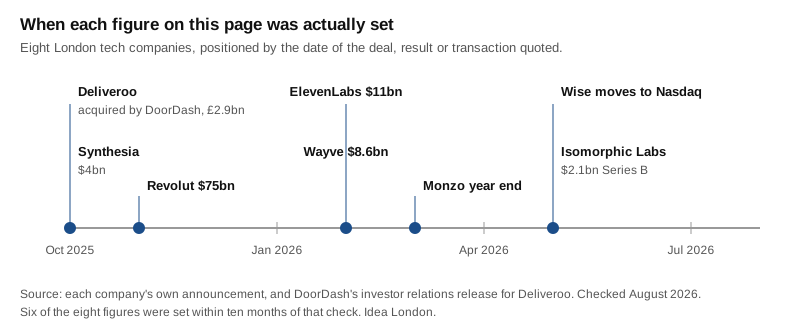
Eight London tech companies, one dated figure each
Revolut. Financial services. Reported $6.0bn of revenue and $2.3bn of pre-tax profit for calendar 2025, with 68.3 million retail customers. Valued at $75bn in a secondary share sale announced 24 November 2025. Became a fully licensed UK bank on 11 March 2026. More in the fintech list.
Monzo. Digital bank. Revenue of £1.7bn and adjusted pre-tax profit of £172.6m for the year to 31 March 2026, its third consecutive profitable year. 15.2 million customers and £25.7bn of deposits, from its own annual report.
Wise. Cross-border payments. Moved its primary listing to Nasdaq on 11 May 2026, keeping a secondary listing in London and its London headquarters. As a listed company its numbers are quarterly and public, which makes it the easiest company on this page to verify.
Wayve. Self-driving software. Raised a $1.2bn Series D at an $8.6bn valuation, led by Eclipse, Balderton and SoftBank Vision Fund 2, announced 25 February 2026.
ElevenLabs. Voice AI. Raised a $500m Series D led by Sequoia Capital at an $11bn valuation, announced 4 February 2026.
Synthesia. AI video generation, co-founded by a UCL professor. Valued at $4bn in a $200m round in October 2025, confirmed by UCL.
Isomorphic Labs. Drug design, spun out of Google DeepMind in King’s Cross. Closed a $2.1bn Series B in May 2026. No valuation was disclosed with the round, so we do not give one.
Deliveroo. No longer independent. DoorDash completed its acquisition on 2 October 2025 at 180p a share, valuing Deliveroo at about £2.9bn. It appears here because it still sits on most London tech lists as a standalone company.
Four of those eight had their headline number set in 2026. Two were set in 2025. One company on the list has been acquired outright. That churn rate is the reason a profile without a date is close to worthless.
Building a profile yourself
Every UK company files, and the filings are free. For a private company this beats any paid summary, because you are reading the primary document.
- Companies House. Search the company name, then open the filing history. Annual accounts give revenue, losses, cash and employee numbers. Form SH01 records share allotments, which means the number of shares issued and the price paid in a funding round. Multiply by the fully diluted share count and you have a floor for the post-money valuation.
- The confirmation statement. This lists shareholders and persons with significant control. It shows who actually owns the company, which press coverage rarely does.
- The company’s own announcements. A priced round with a named lead investor and a stated valuation is the strongest evidence available. Every valuation on this page comes from one.
- The FCA register, if the company is regulated. It shows the permissions held and whether authorisation is restricted.
- The filing dates. An overdue set of accounts is a signal. So is a company that has switched to filing micro-entity accounts after previously filing full ones.
Two traps worth naming. Small companies file abridged accounts that omit revenue entirely, so absence of a figure is not evidence of a bad year. And group structures mean the trading entity you want may not be the one with the recognisable name; check for a holdings company above it.
What we removed from the older version of this page
The previous version of this page claimed a database of over 10,000 London tech companies, £180bn of combined valuation, 2.3 million tech jobs and profiles covering revenue, executives, partnerships and clients for each one.
No such database existed on this site, and none of those four figures cited a source. They have been removed rather than restated. The Dealroom counts at the top of this page are the nearest verifiable equivalent, and they are counts of venture-backed companies rather than all tech businesses, which is a narrower thing.
Frequently asked questions
How many IT companies are there in London?
37,065, on the ONS UK Business Counts figure for 2026, taken from the business register on 13 March 2026 and published on 24 September 2026. That is up 525 from 36,540 a year earlier. It counts enterprises in SIC division 62, computer programming, consultancy and related activities. London holds just under 30% of the UK total of 123,990.
Is there a 2026 figure for IT companies in London?
Yes. The 2026 edition of UK Business Counts went live on 24 September 2026, earlier than any edition since at least 2019, and gives London 37,065 IT companies. The next count, for 2027, is due in late September or October 2027.
What is the difference between an IT company and a tech company?
An IT company sells technology as a service to other organisations: support, consultancy, integration, managed infrastructure, bespoke development. It bills for time and for contracts. A tech company sells a product of its own to a market, and is usually funded by investors rather than by clients. The same firm can drift between the two, which is why search results for the two phrases overlap so heavily.
Which London borough has the most IT companies?
Westminster, with 3,160 in 2026, just ahead of Camden on 3,145, which led in 2025. Hackney is third on 2,750, and Islington and the City of London complete the top five. Outer boroughs place higher than most people expect, because a one-person consultancy is registered wherever its director lives.
Which is the biggest IT company headquartered in London?
Endava plc, on published revenue: £772.3m for the year to 30 June 2025. Capita is larger overall but is a business-process and technology group rather than an IT services firm, and the UK’s biggest IT resellers, by revenue, are based outside London.
How do I check an IT company in London is real before hiring it?
Four free checks, in order. Open its Companies House record for the filing history, the accounts and the people with significant control; late or micro-entity accounts after a run of full ones is a signal. Search the Digital Marketplace to see whether it holds a public sector cloud agreement and what it charges. Verify any Cyber Essentials badge on the IASME certificate search rather than trusting the logo, since it only returns certificates issued in the last 12 months. Then check the trading entity is the one you are contracting with, since a group often puts the recognisable name on a holding company that does no trading.
How do I find IT companies in a particular part of London?
Use the Companies House advanced search rather than a directory. Set company status to Active, enter a London postcode district in the registered office address box, and enter a SIC code: 62020 for IT consultancy and managed services, 62012 for business software development, 62030 for computer facilities management. That returns every registered firm of that type in the area, including the ones that never pay to be listed anywhere.
How many tech companies are there in London?
There is no single authoritative count, because it depends entirely on what counts as a tech company. Dealroom tracks 11,500 funded startups in the city as at August 2026. That figure covers companies that have raised institutional money, so it excludes bootstrapped and self-funded businesses.
Where can I find free company profiles for London businesses?
Companies House, for any UK-registered company. It gives accounts, shareholders, directors and share issuances at no cost. Commercial databases repackage the same filings with an interface on top.
Which London tech companies are worth the most?
Revolut, at $75bn set in November 2025, is well clear of the rest. ElevenLabs at $11bn and Wayve at $8.6bn follow, both set in February 2026. The full ranking, with the deal behind each mark, is in the valuation tracker.
Does London have more IT companies than the rest of the UK?
No, but it is close to a third of the country on its own. London’s 37,065 is 29.9% of the UK’s 123,990, and the city has about half as many again as the South East, the next largest region on 24,800. The three smallest, Northern Ireland, the North East and Wales, come to 6,195 between them, a sixth of London’s total.
How many large IT companies are there in London?
140 employ 250 people or more, out of 37,065 in 2026. Another 685 are medium sized at 50 to 249 employees. So if you need a supplier with a deep bench rather than one contractor, the real pool is around 825 firms, not tens of thousands, and 91% of the city’s IT companies employ fewer than ten people.
What should I look for in an IT company in London?
Evidence you can check without asking the company for it. Its Companies House filing history, for how long it has traded and whether the accounts are filed on time; a current Cyber Essentials certificate on the IASME search rather than the logo on its website; an entry on the ICO register of fee payers, because it will be processing your data; and a published day rate on the Digital Marketplace if it sells to government. Those four take about twenty minutes between them and none of them can be bought. What they will not tell you is whether the work is any good, which is what references are for.
Is G-Cloud 14 or G-Cloud 15 the one to check?
Both, for now. G-Cloud 15 suppliers are published on the Digital Marketplace and the framework goes live in the week beginning 7 September 2026, while G-Cloud 14 runs until it expires on 28 October 2026. Checking both catches the firms that have moved across and the ones that have not.
Sources
-
Publication dates for each year of UK Business Counts read from the Nomis series metadata for NM_142_1 on 16 September 2026 and again on 4 October 2026, when it showed the 2026 edition released at 1pm on 24 September 2026.
-
ONS UK Business Counts, enterprises by industry and employment size band, 2026 release (Nomis NM_142_1, SIC division 62), read on 4 October 2026 for every 2026 count of IT companies by region, borough, size and SIC class on this page. The 2026 figures are drawn from the Inter-Departmental Business Register snapshot of 13 March 2026, per the ONS bulletin of 24 September 2026, which is also the source for the all-business rise in every region.
- The same dataset, 2025 release, for every count of IT companies by region, borough and size on this page. The figures are drawn from the Inter-Departmental Business Register snapshot of 14 March 2025 and are rounded by the ONS to the nearest five. The 2018 to 2024 series and the borough-level year-on-year changes were read from the same Nomis dataset (NM_142_1, SIC division 62) on 3 September 2026; 2025 was still the latest release available.
- Companies House advanced search, for SIC codes and for the Capita registered office and incorporation date.
- Endava plc fiscal 2025 results, announced 4 September 2025.
- G-Cloud 14 (RM1557.14) and G-Cloud 15 (RM1557.15), Government Commercial Agency, for the agreement dates, supplier numbers and the 1 April 2026 renaming of Crown Commercial Service.
- Dealroom London city profile, for the venture-backed ecosystem counts.
- IASME NCSC certificate search, for verifying a Cyber Essentials or Cyber Essentials Plus certificate and the twelve-month window it covers.
- Information Commissioner’s Office register of fee payers, for checking a supplier has paid the data protection fee.
- Companies House SIC code list, for the division 62 codes and their official wording.
Company counts checked against the ONS series on 18 August 2026; the procurement agreement dates and the Companies House record on the same day. The Companies House, IASME and ICO search tools were checked on 25 August 2026.