Six British healthtech companies with what they do, their latest funding and their NHS reach, checked August 2026, plus the big names that no longer trade.
British Healthtech Startup List
British healthtech has an unusually high failure rate among its best known names. Three companies that headlined every UK digital health list between 2019 and 2022 are now delisted, in administration or absorbed into a US buyer.
That is the reason this list is short and dated. Each company below was checked in August 2026 against its own published material. Where a funding figure is given, it is the most recent round the company itself has announced.
Companies trading now
Isomorphic Labs
AI drug design. Spun out of Google DeepMind and based in London.
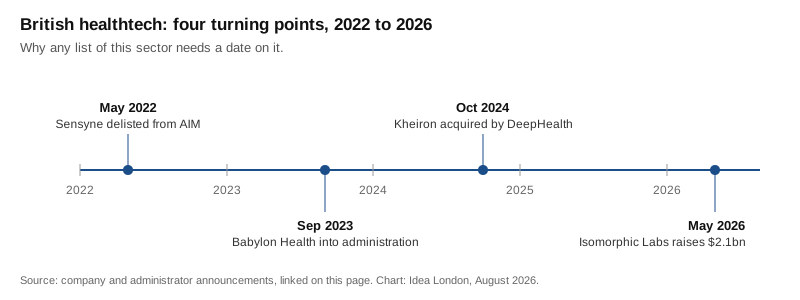
It closed a $2.1bn Series B in May 2026, led by Thrive Capital with Alphabet, MGX, Temasek and the UK Sovereign AI fund. That was the largest single round raised by any UK company in the first half of 2026. Total capital raised is around $2.6bn. It has drug design partnerships with Eli Lilly and Novartis, and a first human trial scheduled.
No valuation was disclosed with the round, so it does not appear in the valuation tracker.
Huma
Remote patient monitoring and software as a medical device. Founded in London in 2011.
Huma completed a Series D in July 2024 with total financing of over $80m. Its regulatory position is the more interesting part of the record: EU MDR Class IIb approval and US FDA 510(k) Class II clearance in 2023, Saudi FDA Class C the same year, India Class C in 2024 and a Health Canada Class II licence in 2025. Pharmaceutical partners it names include Pfizer, Merck, Bayer and UCB.
Doccla
Virtual wards. Patients are monitored at hospital level from home using a pre-configured tablet and wearables.
Doccla is the most heavily deployed company on this list inside the NHS. Figures it publishes on its own site, checked August 2026: presence across more than 60% of NHS regions, over 2,500 new patients onboarded a month across the UK and Ireland, and 591,463 remote clinical assessments in 2025. Named trusts include Barts Health, King’s College Hospital and Northern Care Alliance. It also operates in eleven European countries.
Those are company-reported numbers, not audited figures. They are specific enough to be worth citing and to be checked against later.
Brainomix
AI imaging analysis for stroke and lung disease. Oxford, spun out of the University of Oxford.
Brainomix reports more than 18 regulatory clearances, over 3.5m scans analysed, and deployment in more than 20 countries. Its stroke product carries an EU CE mark and its e-Lung product has FDA clearance. The clinical claim worth checking is a doubling of thrombectomy rates across its NHS network, published in The Lancet Digital Health in 2025 and covering 107 hospitals and 452,000 patients over five years.
Healx
AI for rare disease drug discovery. Cambridge.
Healx has moved from platform to clinic, which is the transition most AI drug companies are judged on. It has dosed the first patient in a Phase 1/2 trial of HLX-4310, aimed at sarcomas with a focus on osteosarcoma.
Lindus Therapeutics
Formerly Lindus Health. Worth flagging because the description on most lists is now wrong.
Lindus started as a clinical trials company rebuilding the contract research organisation model. It has repositioned to in-licensing clinical-stage drug assets and developing them through its own trial operating model. Total funding raised is $80m. The team is over 120 people across the US and Europe, with partnerships in Asia-Pacific.
Names this list used to carry
Any healthtech list written before 2023 will name at least one of these. All three should be read as history.
- Babylon Health. Went public in 2021 at a valuation of about $4.2bn. The rescue merger with MindMaze fell through in August 2023. The US arm filed for Chapter 7, and the UK business wound down with its assets sold in September 2023.
- Sensyne Health. Delisted from AIM in May 2022 after warning that a cash shortfall threatened its ability to keep operating. NHS trusts that had taken shares in exchange for data access lost most of that value. The company was renamed Arcturis Data.
- Kheiron Medical Technologies. Still a going concern, but no longer British or independent. Its Mia breast screening product was acquired by DeepHealth, RadNet’s subsidiary, in October 2024.
Frequently asked questions
How many healthtech startups are there in the UK?
There is no reliable single number, and any page that gives you one without naming its source is guessing. The count depends entirely on where you draw the line between healthtech, biotech, medtech and medical devices. Ask which definition produced the figure before you use it.
Which British healthtech company has raised the most?
Isomorphic Labs, at around $2.6bn total, after a $2.1bn Series B in May 2026. It was the largest single UK funding round of the first half of 2026 in any sector.
What happened to Babylon Health?
It collapsed. The rescue merger with MindMaze fell through in August 2023, the US arm filed for Chapter 7, and the UK business wound down in September 2023 with its assets sold. It had been valued at about $4.2bn when it went public in 2021.
Which of these companies are actually used by the NHS?
Doccla is the most widely deployed of the six, reporting presence across more than 60% of NHS regions and naming trusts including Barts Health and King’s College Hospital. Brainomix reports an NHS stroke network spanning 107 hospitals. Huma’s platform is used in NHS settings alongside its international deployments.
Is this list complete?
No, and it does not claim to be. It carries companies whose current status could be verified in August 2026 against their own published material. A short list that is true is more use than a long one that is not.
What was removed from this page
The previous version of this list opened with two headline figures: 500 or more active healthtech startups, and £2.8bn of investment since 2020. Neither carried a source. Neither could be reproduced, and a sector count in particular depends entirely on where you draw the boundary between healthtech, biotech and medical devices. Both are gone.
Also removed: a claimed 127% year-on-year funding increase in 2023, a claim that London holds 40% of UK healthtech startups, quotes attributed to staff who cannot be verified, and an offer to access a database of 500 company profiles that did not exist.
Babylon Health and Sensyne Health were both presented on the old page as leading current companies, with Babylon described as a £1.2bn public company and Sensyne as raising a £60m Series C. Both had already failed. That is the single strongest argument for dating every figure on a page like this one.
Related lists: London fintech companies, UK SaaS company database and university spinout companies.