HESA's register lists 2,537 active UK university spinouts, with 141 founded in 2024-25 against a peak of 202. Cambridge leads on volume, Oxford on value created.
University Spinout Companies UK
Two organisations now count UK university spinouts properly, and they count different things. The Higher Education Statistics Agency runs a register of every spinout universities declare. The Royal Academy of Engineering, with Dealroom, tracks the ones that raised venture capital.
Between them you get both halves of the picture: how many exist, and how many amount to anything. Checked August 2026.
How many there are
The HESA spin-out register is the fullest count. Its 2024-25 figures, reported on 30 April 2026:
- 2,537 active spinouts on the register, excluding 28 withheld for commercial reasons.
- 141 founded in 2024-25, down from a peak of 202 in 2020-21.
- 1,776 have stayed active for three years or more, up 5.3% year on year.
- Cambridge has the most active spinouts at 305, followed by Oxford at 244.
Formation is slowing while survival improves. Fewer companies are being spun out, and a higher proportion of them last. Other commercialisation measures moved the same way: patents granted fell to 1,548 from 1,779, and intellectual property revenue slipped to £299m from £305m.
Which universities create value
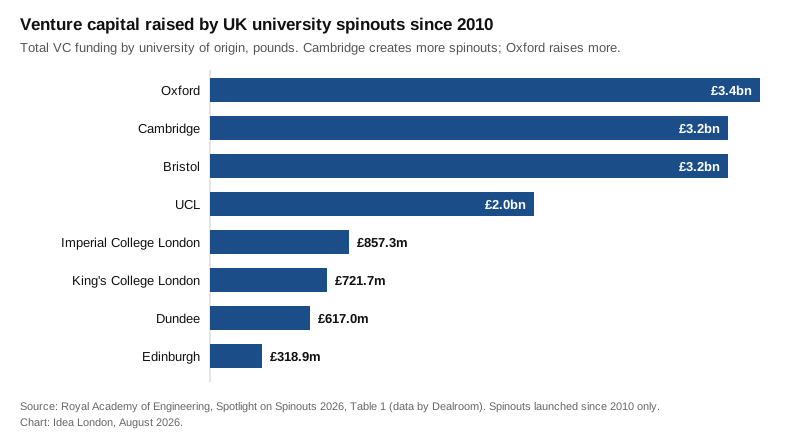
The Academy’s Spotlight on Spinouts 2026 ranks universities on six measures, covering spinouts launched since 2010. The top ten:
| University | VC-backed spinouts | Raised $10m+ | Unicorns and $1bn+ exits | Total VC funding | Combined enterprise value |
|---|---|---|---|---|---|
| Oxford | 129 | 66 | 2 | £3.4bn | £13.5bn |
| Cambridge | 144 | 64 | 1 | £3.2bn | £10.4bn |
| UCL | 64 | 24 | 2 | £2.0bn | £5.5bn |
| Bristol | 46 | 15 | 1 | £3.2bn | £8.5bn |
| Imperial College London | 66 | 20 | 0 | £857.3m | £3.4bn |
| Dundee | 11 | 4 | 1 | £617.0m | £919.0m |
| King’s College London | 22 | 11 | 0 | £721.7m | £2.8bn |
| Manchester | 30 | 6 | 0 | £195.7m | £801.1m |
| Sheffield | 22 | 5 | 0 | £82.5m | £326.3m |
| Edinburgh | 28 | 11 | 0 | £318.9m | £887.3m |
Cambridge creates more spinouts, Oxford creates more value. Bristol is the strongest performer outside the Golden Triangle, largely on Graphcore and the Bristol-founded quantum company PsiQuantum. Dundee sits sixth on eleven spinouts, almost entirely because of Exscientia.
Across the whole cohort since 2010, the Academy counts more than 2,000 spinouts worth £49bn, employing 27,000 people. Seventy per cent of those jobs were created since 2020.
The funding has gone the other way
UK spinouts raised £1.3bn of venture capital in 2025, the lowest figure since 2021, when they raised £2.7bn. Over the same period VC funding for the rest of UK tech grew 46%, driven by AI and a fintech recovery.
Just under 130 rounds above £1m were raised in 2025, slightly down on recent years. The largest:
| Company | Round | Field | University |
|---|---|---|---|
| Draig Therapeutics | £107m Series A | Neuropsychiatric medicine | Cardiff |
| CellCentric | £94m Series C | Targeted cancer therapy | Cambridge |
| PolyAI | £69m Series D | Conversational AI | Cambridge |
| Nu Quantum | £47m Series A | Quantum communication | Cambridge |
| Ultromics | £47m Series C | AI cardiology diagnostics | Oxford |
| Wild Bioscience | £45m Series A | Climate resilient crops | Oxford |
| Paragraf | £44m Series C | Graphene electronics | Cambridge |
| Chemify | £43m Series B | AI drug synthesis | Glasgow |
Cambridge accounted for four of the top eight. The largest single round went to Cardiff.
Spinouts convert better than the rest of UK tech despite the funding dip. Almost a third that raised a seed round between 2010 and 2020 went on to a Series A, and the conversion rate to Series C runs about 21% higher than the wider startup population.
Exits
Two of the six billion-dollar European spinout exits in 2025 came from Oxford:
- OrganOx, organ transplant technology, acquired by Terumo. The Academy values the exit at £1.2bn.
- Oxford Ionics, trapped-ion quantum computing, acquired by IonQ. Valued at £840m in the Academy’s table, and completed on 17 September 2025 at $1.075bn.
The largest spinout exits of the last decade are still dominated by life sciences, which accounts for 17 of the top 20. The biggest was Abcam, acquired by Danaher for £4.5bn in 2023. The largest IPOs were Oxford Nanopore at £3.4bn and Exscientia at £2.1bn, both in 2021.
The IPO route has been largely shut since then. Exits over the last three years have come almost entirely through acquisition. The recent ones spread beyond biotech: medical devices with OrganOx, quantum with Oxford Ionics, and semiconductors with Graphcore, which SoftBank bought for £470m in 2024.
University equity stakes have fallen
This is the part that changed most, and it is the part founders ask about first.
The average stake a university takes has dropped from 25% to 30% in the 2015 to 2019 period, to below 20% across 2024 and 2025. The Academy puts the current average at 16%, a historic low, with far less variation than before. Recent averages by type:
- life sciences spinouts: 20%
- hardware spinouts: 14%
- software spinouts: 17%
The first two sit inside the ranges recommended by the 2023 Independent Review of University Spinout Companies. Software is above its recommended range. The USIT Guide, published by TenU in 2023 and updated since, is the document those ranges come from, and 69 English universities have signed up to it.
One caveat the 2026 report adds: around 30% of spinouts secured external investment before their equity split was made public, so historic average stakes were under-reported because of earlier dilution.
Frequently asked questions
How many university spinouts are there in the UK?
2,537 active companies on the HESA spin-out register for 2024-25, excluding 28 withheld for commercial reasons. Of those, 1,776 have been active for three years or more.
Which UK university produces the most spinouts?
Cambridge, on both counts. It has 305 active spinouts on the HESA register and 144 VC-backed spinouts since 2010. Oxford is second on volume and first on value created, with £3.4bn of VC funding and £13.5bn of combined enterprise value.
How much equity does a UK university take in a spinout?
Around 16% on the latest average, down from 25% to 30% a decade ago. Recent averages are 20% in life sciences, 14% in hardware and 17% in software. The 2023 USIT Guide set the recommended ranges that drove the fall.
Is UK spinout activity growing?
No, not on volume or funding. New formations fell to 141 in 2024-25 from a peak of 202 in 2020-21, and VC funding into spinouts fell to £1.3bn in 2025, the lowest since 2021. Survival rates and exit values held up.
What is the biggest UK university spinout exit?
Abcam, a Cambridge spinout, acquired by Danaher for £4.5bn in 2023. The largest IPO was Oxford Nanopore Technologies at £3.4bn in 2021.
What this page dropped
The previous version claimed 2,400+ active spinouts, £15.8bn raised, 180+ universities and 95,000+ jobs created, none of it sourced. Two of those four are now checkable and both are lower: HESA’s register gives 2,537 active companies, and the Academy counts 27,000 jobs across the post-2010 cohort, not 95,000.
Its per-university table was wrong in kind as well as in detail. It credited Cambridge with ARM, which was not a spinout, and UCL with DeepMind, which was not one either: the founders met at UCL’s Gatsby unit, and the £400m acquisition price was never confirmed by Google. The success metrics block (78% five-year survival, £3.2m median Series A, 18 months to first revenue, 23% exit rate within ten years) had no source and has gone, along with the sector percentages and the quote attributed to a research analyst.
Related: UCL engineering startups, the UK venture capital database and UK startup exit analysis.