Eleven UK venture firms, each with a dated public number: Index $3.5bn available, Balderton $1.3bn, Atomico $1.24bn, Seedcamp $320m, plus who is deploying most.
UK Venture Capital Database
A list of 500 firms is not much use to anyone raising money. What matters is which funds have capital they still have to deploy, at what stage, and how recently they raised it. A fund in its final year is a different proposition from one that closed last month.
So this page gives the most recent fund for each firm, its size, and the date it was announced. Checked August 2026.
Firms and their latest funds
| Firm | Stage | Most recent fund | Announced |
|---|---|---|---|
| Index Ventures | Seed to growth | $2bn across three funds: $400m seed, $900m venture, $700m added to the 2024 growth fund. $3.5bn of capital available | 31 Jul 2026 |
| Seedcamp | First cheque, angel to seed | $320m: Fund VII at $220m plus a $100m Select fund | 22 Jun 2026 |
| Balderton Capital | Seed to IPO | $1.3bn: Early Stage Fund IX at $615m, Growth Fund II at $685m | 12 Aug 2024 |
| Atomico | Series A, plus growth | $1.24bn: Venture VI at $485m, Growth VI at $754m | Sep 2024 |
| Molten Ventures | Series A to growth | Listed on the LSE. Gross portfolio value £1,525m, net assets £1,324m | Year to 31 Mar 2026 |
| Octopus Ventures | Pre-seed to Series A | 180+ teams backed, 32 exits, seven core investment areas | Site checked Aug 2026 |
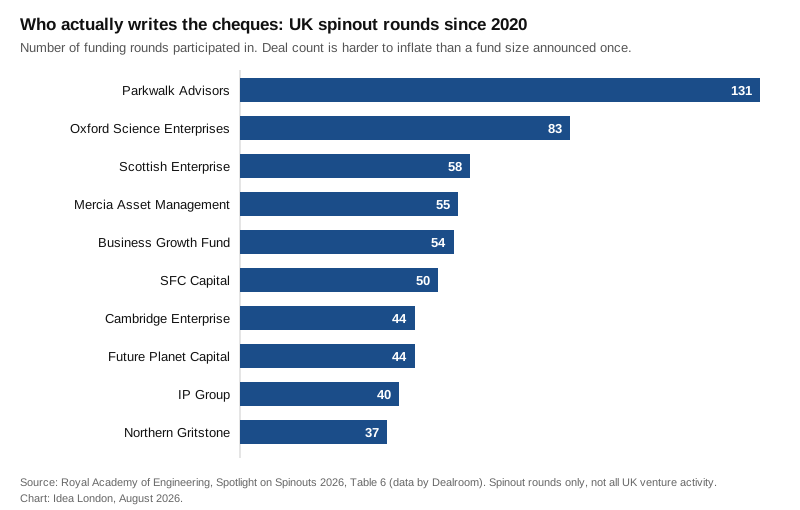
| Parkwalk Advisors | Seed, university spinouts | 131 rounds since 2020, contributing to deals worth £1.1bn | RAEng 2026 |
| Oxford Science Enterprises | Seed, Oxford spinouts | 83 rounds since 2020 | RAEng 2026 |
| SFC Capital | Seed, SEIS and EIS | 50 rounds since 2020 | RAEng 2026 |
| Cambridge Enterprise | Series A, Cambridge spinouts | 44 rounds since 2020 | RAEng 2026 |
| Northern Gritstone | Seed, northern universities | 37 rounds since 2020 | RAEng 2026 |
The deal counts in the bottom five rows come from the Royal Academy of Engineering’s Spotlight on Spinouts 2026, which ranks the most active investors in UK spinouts by number of rounds since 2020. Parkwalk tops that table over both five and ten years.
Two things the table is not. It is not a ranking, because fund size says nothing about whether a firm is a good partner. And it is not complete: it covers firms with a recent, checkable public number, which excludes many active investors who simply do not announce.
Deal count is the honest activity measure
Fund size is announced once and then quoted for years. Deal count is harder to inflate, which is why the spinout table above uses it, and why it puts three university-linked funds ahead of most household names.
The same pattern shows in who backs UK spinouts. The Academy groups the most active investors into four types:
- university-connected funds, such as Oxford Science Enterprises, Northern Gritstone and Albion VC
- spinout specialists, such as Parkwalk Advisors and IP Group
- deep tech specialists, such as IQ Capital, Amadeus Capital Partners and Octopus Ventures
- generalists, such as Mercia Asset Management, Foresight Group and SFC Capital
Public money sits behind a lot of it. Scottish Enterprise Growth Investments made 58 investments since 2020 and the British Business Bank 31, which puts both ahead of several well-known private funds on volume.
How much of this reaches ordinary companies
Very little of the announced billions lands as a first cheque. The British Business Bank’s Small Business Equity Tracker 2026, covering calendar 2025, found:
- seed deal numbers down 27% to 704, the sharpest fall of any stage
- seed value flat at £2.1bn, because mean deal size rose while the median did not
- the median gap between rounds up from 12.4 months to 14.4 months
- London taking 48% of deals and 57% of value, a share that fell for a second year
Q1 2026 was £1.5bn across 418 deals, down 43% on value. The pre-seed and seed page has the detail, including why the rise in average deal size is essentially one transaction.
Meanwhile the national funding total hit a four-year high, at about $17bn in the first half of 2026. Both things are true, and they describe different companies. The funding tracker sets out where that money went.
Checking a fund before you pitch it
- Look for a dated fund announcement. A firm that last closed a fund in 2019 may be managing a portfolio rather than writing new cheques.
- Check Companies House for the manager entity. Filed accounts show whether the firm itself is growing or shrinking.
- Check the FCA register. UK fund managers are authorised or appointed representatives, and the register is free.
- Count recent deals, not logos. Portfolio pages keep exits and write-offs on display for years. A run of announcements in the last six months tells you more.
- Match the stage honestly. A growth fund with a £685m pool is not going to lead your £400k pre-seed, however friendly the first call is.
One name change to know. The trade body most people still call the BVCA adopted the name UK Private Capital on 27 January 2026. It represents more than 600 member firms across private equity, venture capital and private credit. Old links and older articles still say BVCA.
Frequently asked questions
How many venture capital firms are there in the UK?
Nobody publishes a definitive figure, because there is no register of venture funds as such. The trade body now called UK Private Capital has more than 600 member firms, of which a minority are venture rather than private equity or credit. Any precise count you see is somebody’s database boundary, not a fact.
Which UK venture firm has the most capital?
Of those with a recent public number, Index Ventures. It announced $2bn of new funds on 31 July 2026 and said it had $3.5bn of capital available across stages. Balderton’s most recent pair totalled $1.3bn and Atomico’s $1.24bn.
Who invests in UK university spinouts?
Parkwalk Advisors is the most active by deal count, with 131 rounds since 2020 and participation in deals worth £1.1bn. Oxford Science Enterprises, Cambridge Enterprise and Northern Gritstone follow, each tied to specific institutions. See the university spinouts page.
Is it harder to raise seed funding in the UK now?
On the numbers, yes. Seed deals fell 27% in 2025 and Q1 2026 value was down 43% year on year, while the median time between rounds lengthened by two months. The record national totals come from a small number of very large AI rounds.
How do I find a fund’s real cheque size?
Look at its last ten announced deals rather than the range on its website. Round sizes are reported; stated cheque ranges are marketing.
What this page dropped
The previous version claimed 500+ active VC firms, £8.2bn of total investment “in 2023” and 2,400+ portfolio companies, with no source for any of the three. It advertised firm profiles, real-time investment data, network analysis, advanced search, alerts and data export, then priced them at £299 a month for a professional tier and a custom enterprise tier. None of that existed.
The three featured firms were real but described without a single checkable number between them. The quoted claim that fintech and healthtech make up “over 40% of UK VC investments” was attributed to a member of staff rather than to data, and has gone.
Related: the London angel investor list, the UK accelerator directory and the funding tracker.